
This article is part of a set of two: it describes a possible quick and easy way to rock mulch for those who want to just get it done: you will need to determine if it can fit your needs. The second article discusses, much more broadly, what you can do to make your garden look good with gravel!
Why rock mulch
After clearing your Zone 0 of shrubs and brush, you may be left with areas of bare earth that will be very difficult to maintain clear of weeds. One way to make is very easy to maintain is to mulch it with rock. Wood mulch, while convenient, is not allowed in Zone 0, and is dangerous even in Zone 1.
In addition, many of our houses were built before 1978, and, if they were painted, may contain significant lead in the soil adjacent to the house. For any house with a risk of lead exposure, Alameda County recommends covering all loose soil with hardscape: Lead Poisoning Prevention Program - Community Development Agency (CDA) - Alameda County.
Many of the Firewise groups on the Ridge have conducted, over the past two years, clearing work with large parties of volunteers for homeowners who had a hard time doing it themselves, because of physical difficulties, income, or other reasons. We have developed a simple set of rules for rock mulching that provide a process and good aesthetics while keeping costs to a minimum, and is applicable to most houses. This process is described below.
Important warning: this article describes a process that is not applicable to all situations. You are solely responsible for determining if this process is suitable or appropriate to your home. Particularly if you are on a slope—but also in the general case—make sure to figure out the right engineering solution to your project, and consult with hydrologists, geologists or other specialists to determine what the best approach to your project will be.
Where to rock mulch
Zone 0 normally extends 5 ft from your walls. We generally recommend rock mulching wherever clearing your Zone 0 has left bare soil. We assume that the sole purpose of the rock mulch is weed prevention, and that the rock-mulched areas will never serve as children’s playgrounds or paths (otherwise you would consider different types of solutions from what we are proposing here).
Do we dig out the soil?
It would be nice to dig it out the soil to a depth of 4" to 6", but, in reality, it is immensely costly and likely not required if you are not planning on using more than about 2" or 2.5" of rock mulch. The volcanic rock is rough enough not to slide much, and does not need edging (although it looks neater with edging).
Immediately near the wood siding of your home, you may want to look carefully at the clearance you have between the soil and the bottom of the siding. If you have plenty of apparent concrete (more than 8"), it is fine to simply pile the rock on top of the soil. If not, you may need to dig a bit of the soil out to a distance of 12" from the walls in order to make sure that you still have at least 6" of noncombustible material at the bottom of the house. If you do so, make sure that the soil excavated is left in the area that will be covered by fabric and rock mulch (do not spread it out anywhere else if it may be contaminated with lead).
It is also important to make sure that the ground slightly slopes away from the house. So, before applying the fabric, if you need to slightly correct the slope within Zone 0, by all means do so in order to make sure that water is draining away from the house. Also be sure not to spread the soil anywhere else than in Zone 0, where it will be covered by fabric and rock mulch.
Fabric vs no fabric
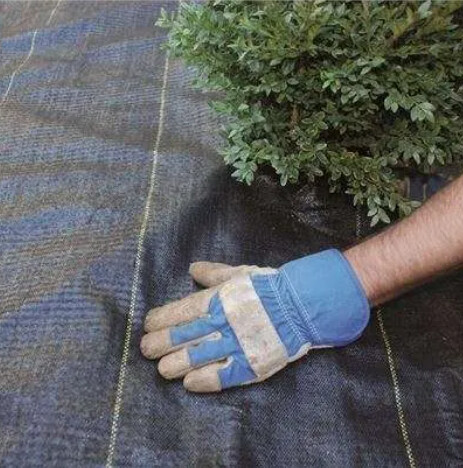
There are many opinions about fabric, and each of of them likely carries some truth. For us, we are only looking at fabric from the point of view of weed prevention. For an equal thickness of rock, fabric prevents more weeds than no fabric. Our general MO includes fabric.
Woven vs non-woven landscape fabric
In Zone 0, in general, we are not particularly looking for more permeable fabrics. We normally use high-quality woven fabrics. We believe that it makes sense to spend a few more dollars buying high quality professional-grade fabric, that will last much longer. At this time we generally use DeWitt Pro-5 fabric, that we order online.
When you order the fabric, also get commercial-grade staples(i.e. longer and thicker). Order more of them rather than less—they only cost a few dollars.
Installing the fabric
This is a detail-oriented job: Every fraction of an inch where the fabric deviates from the exact limit of where it should be installed will get covered by weeds. Looking at Youtube videos, you realize how careless many installers are, who don’t realize how poor a job they are doing. You want the fabric to go to the very edge of where it is supposed to go, and the edge staples to be installed right on that edge. Preferably the last few inches of fabric should be doubled over. Don’t hesitate in over-stapling: the cost of staples is very low, but weeding will cost you a lot of hours, or money.
What rock/gravel to pick
Rock can be very expensive, and it is not always easy to know what will work in your situation. In general, the smaller the rock, the more it will slide in the rain if there is any slope. In the same manner, the smoother the rock (think water-polished), the more it will flow down-slope. But, at the same time, the smaller the rock, the better it will stop weeds!
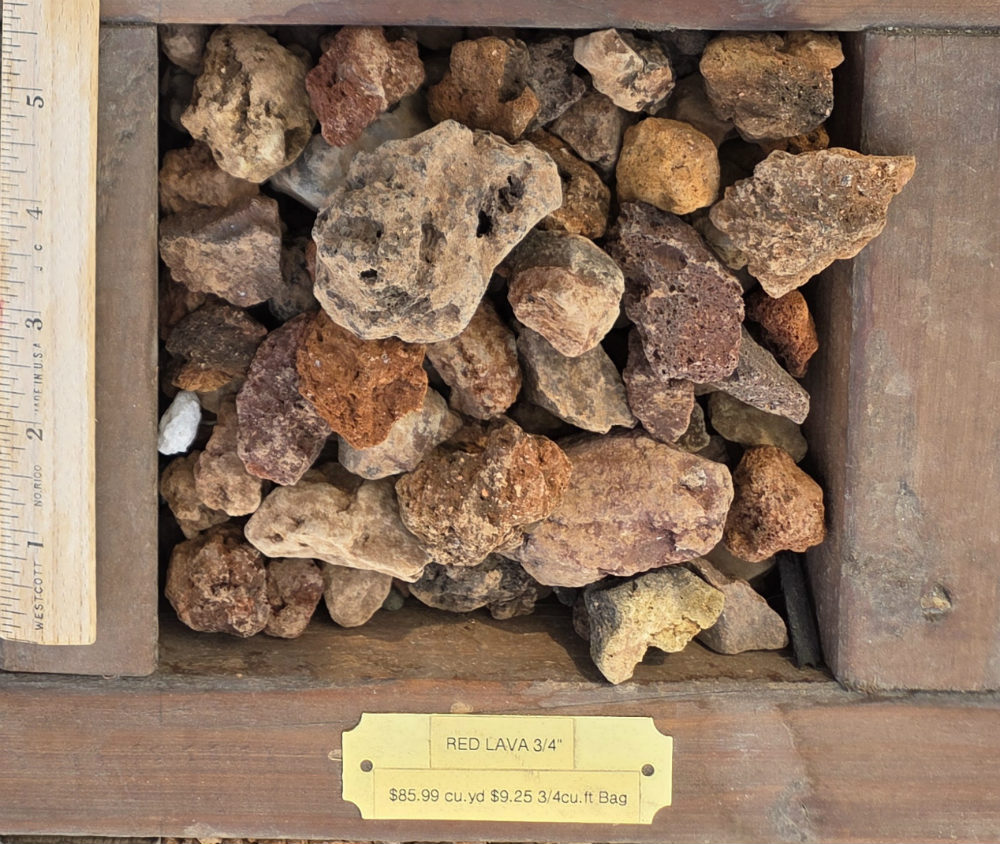
Our “universal” solution is 3/4" lava rock, black or red. Its very rough surface makes it less likely that it will slide. It is large enough not to crumble too fast in the presence of limited walk-over, and small enough to present good obstruction to weeds. It is also very cheap compared to most rocks, in part because it is sold by cubic yard vs. weight. Right now it can be obtained for approximately $100/cubic yard. Because it is sold by cubic yard rather than ton, It is also very easy to calculate how much you need: if you want to spread rock mulch to a depth of, for instance, 2", you know right away that a cubic yard of rock will produce 6 square yards of rock mulch.
As a note, when you purchase rock of a given size, do go and check the bin where it is stored to make sure that the listed size matches the one you are buying. Sometimes, the batch at hand may be a bit off—once delivered, it is too late to complain, so it is best to check at order time.
What depth of rock mulch
Ideally you would like to spread 4" of rock mulch. However, in many cases and for many reasons tit is not possible or economical. In practice, and because we always use rock mulch with woven fabric, we find that 2", or a little over 2", is enough, as long as the rock mulch is not expected to be a walking path. If it is, you will need to plan for stepping stones in the middle of it.
Understand that, if you are dealing with lead exposure, you may need to spread much deeper layers of rock mulch. If that is your situation, you need to consult a lead abatement expert.
How to deal with slope parallel the side of the house
Slope is a difficult issue since it is conducive to erosion and can be dangerous for many reasons. Many houses need drains or French drains to deal with water on the side of the house, in particular in conjunction with downspouts, and consulting an expert is critical.

Our default choice, 3/4" volcanic rock, is rough-sided and does not slide much. In the picture above, this rock is set on a 30% slope. It was installed more than 2 years ago and has not moved at all.
Regardless, assuming that there is no need for special drainage, your standard process calls for the use of a simple form of economical terracing in order to make sure that your rock mulch does not end up sliding down the slope.
We use cheap but heavy rocks (“moss rock”), with an individual size of about 12" per stone, to roughly terrace the grounds. For the width of Zone 0, we need approximately 5 such rocks, roughly in a line. You may need to very slightly bury them with a spade, to a depth of a few inches, simply to give them a solid footing, when positioning them.
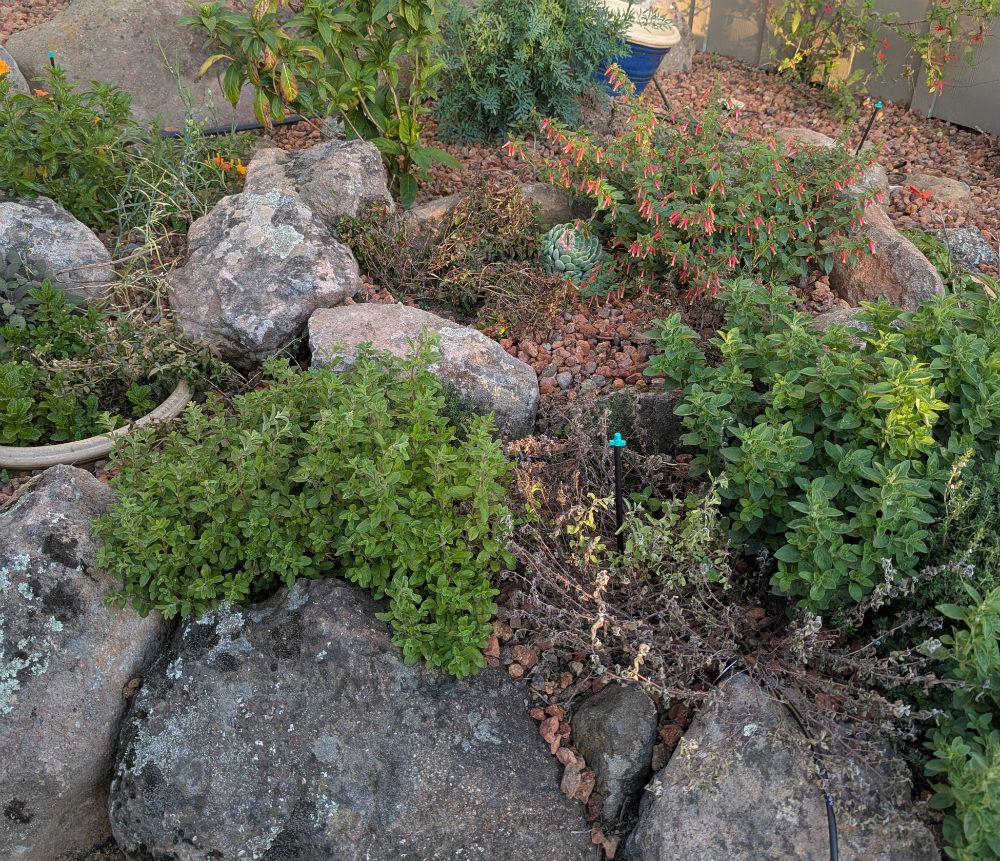
How long do you build your terraces? We use a rule of thumb when we build ours. No slope means no terracing required. “Little” slope means we build a terrace every 8-9 feet. “Medium” slope means we build a terrace every 5-6 feet. “Steep” slope means we build a terrace every 3-4 ft. Between moss rock boundaries, we use volcanic rock as described above.
How much moss rock do you need? We normally expect 70 to 71 rocks per ton, and moss rock normally costs about $280 per ton.
The full process
- Measure the full amount of bare soil to be rock mulched, in square yards
- Calculate the number of cubic yards of volcanic rock needed Right now we can buy 3/4" volcanic rock for about $100 per cubic yard. Don’t forget the delivery fee, generally of about $110 per truckload.
- Calculate the number of terraces to be built, and the amount of “moss rock” (or the cheapest rock you can find with the appropriate size, weight and cost. Make sure to specifically pick the size rock you need (about 12" diameter rocks is what we use). Right now we can buy such moss rock for about $280 per ton, with about 70-71 rocks per ton (we always pick the specific rock pallets we want).
- Don’t forget the delivery fee, generally of $110 per truckload. It is cheaper to buy all the rock you need from the same supplier, so as to only pay a single delivery fee.
- Order the fabric and the staples.
- If you are my age (over 60), hire a day laborer. Pay and feed him well. Stay with him all along to supervise. Make sure to shape the soil first, so as to make it possible to spread the rock easily once the fabric is in place. If you use moss rock for terracing, prep the terrace edges before laying out the fabric, and mark them with extra staples. Roll out the fabric and over-staple it, particularly on the edges.
- Wheelbarrow the rock terrace by terrace, starting with the furthest away. Make sure to push the larger rocks down well. Then wheelbarrow the volcanic rock for the terrace. Then do the next terrace.
Full costs
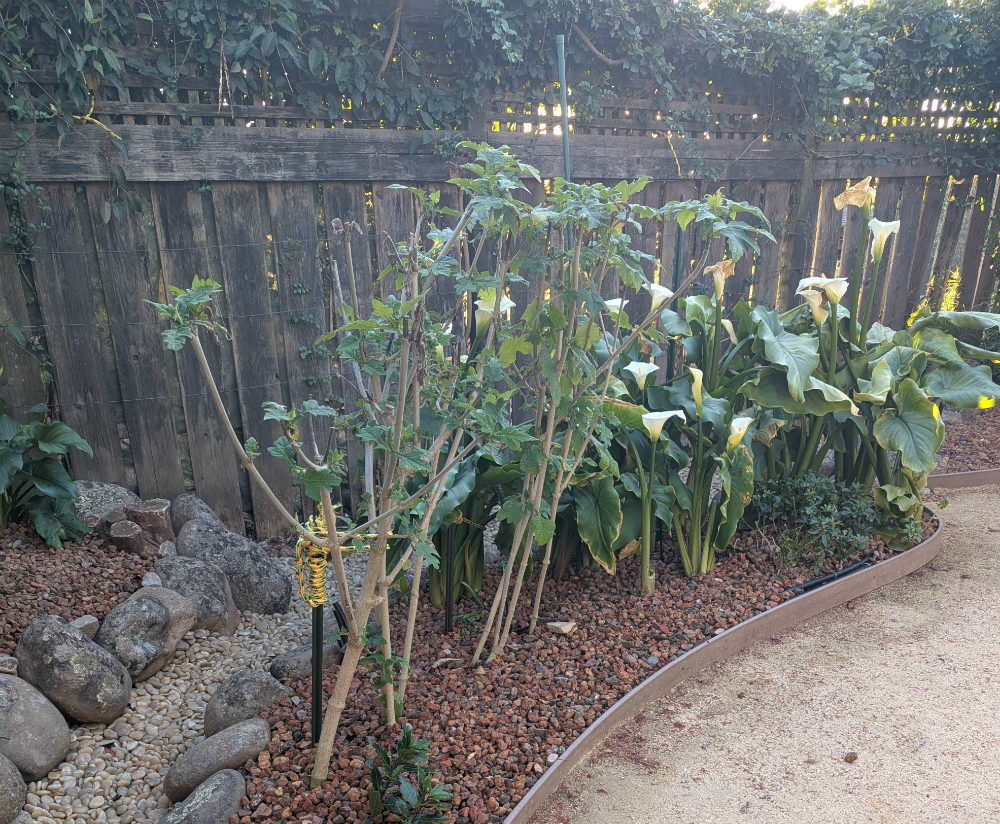
Beyond the cost of materials, expect a person.day of work per 2 tons of moss rock, and a person day of work for 4-5 cubic yards of volcanic rock. Count half a day of fabric work for 2 days of rock laying.
This process may not fit your needs
it is your responsibility to determine what process will fit your needs and your property. Make sure you do your due diligence: you are the only person who can determine what will satisfy the requirements of your property.
Many thanks to Brent Blackaby for suggesting the topic of this article, and for his many useful suggestions!