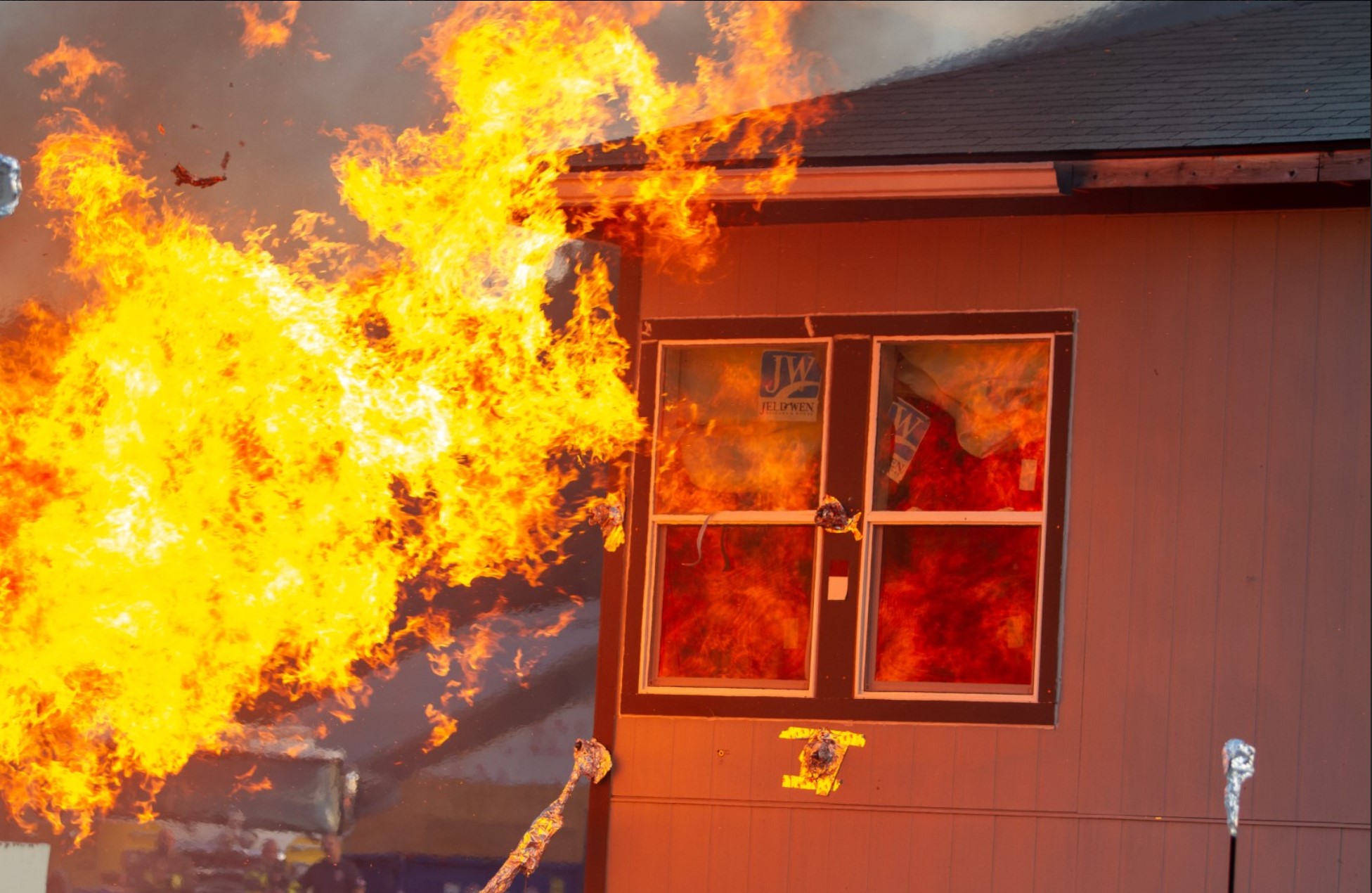
source: IBHS
Most of us, thinking of wildfire, picture a wall of flames moving quickly towards our homes, that tens of fire engines and firefighting planes sometimes fail to stop. The reality is different: embers are the primary cause of the destruction of structures in a wildfire. It is impossible for us to stop a flame wall. It is definitely possible for to stop embers from igniting in our property.
Following are some quotes about embers as a cause for fire:
“Buildings ignite as a result of embers, radiant heat, and/or direct flames. […] Embers are the most common cause of home ignition.” [Firesafe Marin]
"Contrary to popular belief, most homes do not burn down from direct contact with wildfire flames or radiant heat. " [NFPA.org video]
Berkeley Fire Department writes that between 60 and 90% of structures destroyed in a wildfire are ignited by embers. A 2019 study by the Insurance Institute for Business and Home safety, which conducts or funds a large part of the fire research conducted on the North-American continent, concluded that up to 90% of structures that burn in a wildfire are ignited from embers.
From IBHS’s Home Mitigations That Matter (2023):
"Buildings are ignited by embers and flames during wildfires. Flying embers and wind-blown, ground traveling burning debris are by far the most prevalent attack mechanisms threatening structures during a wildfire.
CAL FIRE identified embers as the major cause of home loss (Mell et al., 2010).
Potter and Leonard (2011) reported that “well over 90% of houses were ignited in the absence of direct flame attack or radiant heat (exceeding 12 kW/m2) from the main fire front.”
Hence, embers cause a great deal of damage, whether directly or indirectly. Direct ignition by embers happens when embers land and accumulate on combustible components of the building and ignite these components or when embers enter the building through openings and ignite interior materials.
Small-scale (Richter et al., 2022) and full-scale experimental studies (Cohen, 2000; Davis, 1990; Hedayati et al., 2022; Suzuki et al., 2017) demonstrate that accumulated embers are capable of directly igniting common combustible building components.
Embers can also penetrate through openings and ignite the combustibles, such as furniture, inside a building (Quarles et al., 2010; Robertson, 2013).
Indirect ignition by embers occurs when embers accumulate on combustibles near a building and ignite these materials. The resulting flames ignite a component of the building by radiant heat and/or direct flame contact. These spot fires typically have notably lower intensity relative to the main fire front (Potter & Leonard, 2011), but under favorable conditions, these spot fires can spread to nearby structures. It is important to note that only tall, thick flames can radiate sufficient heat to ignite buildings, while smaller flames need to be close or in contact with the building to cause ignition (Himoto, 2022). "
Sources
- Cohen, J. D. (2000). Preventing disaster: home ignitability in the wildland-urban interface. Journal of Forestry, 98(3), 15-21.
- Davis, J. B. (1990). The wildland-urban interface: paradise or battleground? Journal of Forestry, 88(1), 2631.
- Hedayati, F., Quarles, S. L., & Standohar-Alfano, C. (2022). Evaluating Deck Fire Performance—Limitations of the Test Methods Currently Used in California’s Building Codes. Fire, 5(4), 107.
- Himoto, K. (2022). Large Outdoor Fire Dynamics. CRC Press.
- Mell, W. E., Manzello, S. L., Maranghides, A., Butry, D., & Rehm, R. G. (2010). The wildland–urban interface fire problem–current approaches and research needs. International Journal of Wildland Fire, 19(2), 238-251.
- Potter, M., & Leonard, J. (2011). Spray system design for ember attack-Research findings and discussion paper.
- Richter, F., Bathras, B., Barbetta Duarte, J., & Gollner, M. J. (2022). The Propensity of Wooden Crevices to Smoldering Ignition by Firebrands. Fire Technology, 1-22.
- Quarles, S. L., Valachovic, Y., Nakamura, G. M., Nader, G. A., & De Lasaux, M. J. (2010). Home survival in wildfire-prone areas: building materials and design considerations.
- Robertson, S. (2013). Building in bushfire zones. Sanctuary: Modern Green Homes(25), 80-83.
- Suzuki, S., & Manzello, S. L. (2017). Experimental investigation of firebrand accumulation zones in front of obstacles. Fire Safety Journal, 94, 1-7.
- Suzuki, S., Nii, D., & Manzello, S. L. (2017). The performance of wood and tile roofing assemblies exposed to continuous firebrand assault. Fire and Materials, 41(1), 84-96.