A recent article published in The Conversation and the LA Times has ignited interesting discussions about wildfire science and the science behind Zone 0. The article, an op-ed in the LA Times, is titled “California plan to ban most plants within 5 feet of homes for wildfire safety overlooks some important truths about flammability,” and is authored by two wildfire scientists.
I do not believe there is a person in any California WUI who does not wish to save as many of their plants as possible in the process of achieving wildfire resilience. As one of many homeowners affected by the new defensible space requirements, I was fascinated by the title. I just spent more than a week parsing the article sentence by sentence and reference by reference. My purpose was to find out if there is solid evidence (“facts”, “data”) behind the article to back up the strong title. If there is, this would give us a chance to, possibly, (1) most importantly, change the way we can make our own yards and houses more fire-resistant, and (2) also valuable, make changes to the upcoming regulations that the state will push on us all this year.
The present article analyzes in detail the article in question, and parses both contents and references, looking for evidence. Because the analysis is painstakingly detailed, I am also giving a TLDR:
Summary
Unfortunately, as evaluated in the present analysis through parsing section after section and study after study [more than a week’s work], none of the many links provided by the authors or by the authors’ reference studies provides evidence to support either (a) the authors’ conclusions or (b) their various assertions supporting their title. In fact, when evidence is provided, it supports the enforcement of a strict Zone 0, or evidence in support of a strict Zone 0, such as removing herbaceous growth in Zone 0 and leaving moist trees.
It does not mean that the authors’ assumption is false. It does mean that it is unproven and that, at this time, there is no scientific evidence behind this Op-Ed.
The authors
Moritz is a “Specialist” at the Cooperative Extension of UC Agriculture and Natural Resources (UCANR), a public university system headquartered in Davis, where he leads a small fire lab. He also holds a contract position at UC Santa Barbara, where he occasionally teaches courses in an adjunct capacity. His publication record demonstrates consistent contributions to the field.
Carmignani has been an assistant professor at San Diego State University, it appears, for a year. He earned his PhD in 2019, followed by two years of postdoctoral work, then spent two years at UCANR as a Fire Advisor for the Wildland-Urban Interface (WUI). His academic and professional trajectory to date reflect a strong foundation and steady progress.
The form of the article
The paper is an op-ed. According to the Cambridge Dictionary, an op-ed is “used to describe a piece of writing that expresses a personal opinion and is usually printed in a newspaper opposite the page on which the editorial is printed.” An opinion paper is obviously not peer reviewed. It does not, therefore, introduce new evidence, but it could definitely quote some.
As an opinion paper, it does not have as much value as a research paper, but it could still have plenty if it quotes strong evidence. We will now parse every section.
Introduction
The authors give generally accepted anecdotal evidence that some vegetation survives fire, sometimes right next to burnt out structures. They introduce their thesis: “we recognize that well-maintained plants and trees can actually help protect homes from wind-blown embers and slow the spread of fire in some cases.” So far, nothing to say. Obviously, at this stage, no evidence.
Lessons from the devastation
The authors state that “research into how vegetation can reduce fire risk is a relatively new area of study” and provide a link to a review article by a group of Chinese researchers (The Role of Urban Vegetation in Mitigating Fire Risk Under Climate Change: A Review), who got a grant to write the article—again, no evidence. I was disappointed by the article, which gave me two days of work to track down the critical references but did not unearth any article of significance. The main issue, it appears, is that there is no accepted framework of reference, and that the way to actually approach measurements (for instance, for measuring the type of ground or vegetation from a satellite) is not well understood.
The authors follow this mention by more anecdotal evidence about vegetation that has not burned near fully consumed homes. Plenty of wildfire researchers take issue with this, though, since there could be many reasons why the vegetation did not burn that have nothing to do with a protective role for the vegetation—for instance, it could have to do with the turbulence of the fire. And, sure enough, the illustrative picture for this section, taken by one of the authors, points out exactly why—can you see it?
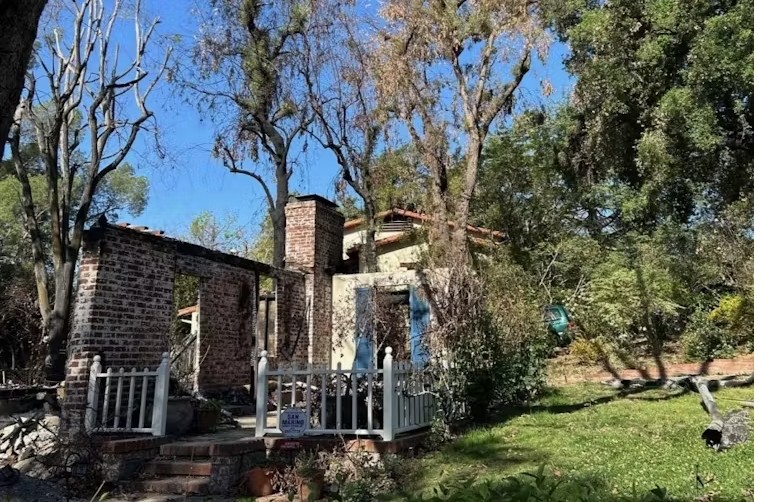
Moritz picture: Unburnt shrubs near a fully consumed home
To the left we see a fully burnt down home. To the right we see mostly intact shrubs and lawn. A first sight we could take this to mean that the vegetation was protective/ protecting itself. In reality, looking at the picture with more attention, we also notice that none of the wood banister around the deck between the house and the shrubs burned either. Was the dead wood that the banister was made of protective too? This picture, provided by Moritz himself, actually makes a different point—fire is a turbulent, nonlinear phenomenon, that does not linearly burn through everywhere. There is no evidence to be found in anecdotal discussion of unburned vegetation.
The authors then list a few traditional home hardening steps, mention that “fire-resistant” vegetation is not truly fire-resistant [i.e. not fireproof] (we know that), and conclude that “What matters more for keeping plants from becoming fuel for fires is how well they’re maintained and whether they’re properly watered” along with a link that simply discusses flammability of vegetation.
Here, I am starting to feel uncomfortable about the logic of the authors:
- everyone agrees that well-watered and maintained plants will not burn as easily. The question, though, is whether the authors can show evidence they won’t burn at all or contribute to the burning of a nearby home—there is still no evidence so far.
- the link they give (https://anrcatalog.ucanr.edu/pdf/8695.pdf), a UCANR publication whose authors include Quarles, actually recommends reliance on a strict Zone 0.
How a plant bursts into flame
The authors discuss how higher humidity in plants cool the environment (with a qualitative link only, but I think we all agree with that), and makes the plant harder to burn (we all agree with that too). They state that “high moisture can actually keep a plant from igniting” but immediately comment that “With enough heat […] a nearby spark or flame can […] set the plant on fire.” In other words, it doesn’t burn until the radiated heat evaporates most of the water, at which times it burns.
We finally get to the point in the article where the authors actually seem to point at evidence: “Up to the point that they actually burn, green, well-maintained plants can slow the spread of a fire by serving as ‘heat sinks,’ absorbing energy and even blocking embers. This apparent protective role has been observed in both Australia and California studies of home losses”, with two links for studies in Australia and California. I will discuss these studies in the next section—they really are the critical part of the article and deserve their own separate analysis.
Finally, the authors conclude that “how often vegetation buffers homes from igniting during urban conflagrations is still unclear.” At first sight, this conclusion is puzzling: the authors are saying there is really no science that says how much vegetation protects homes, and where—so where is their evidence? It appears that they already discount the evidence given in the two links that we will discuss below. Let’s find out why.
The two critical studies
We need to quote them both because they are the core of the evidence that this article relies on. One is Options for reducing house-losses during wildfires without clearing trees and shrubs, by Gibbons, Gill et al. (the Australian study), and the other is Exploring urban vegetation type and defensible space’s role in building loss during wildfire-driven events in California by Escobedo, Yadav, et al. (the California study). I obtained a full text article for both to be able to parse them in toto.
The Australian study
The Australian study evaluates 3 hypotheses: (1) Maintaining ‘greener’ vegetation around houses provides additional protection from wildfires; (2) Retaining trees in shrubs as discrete clumps affords houses greater protection; and (3) Trees and shrubs in the downwind direction from houses pose less risk than in the upwind direction. Let’s discuss these three hypotheses in inverse order.
The article’s discussion for (3) was that “for any given distance between houses and a large patch of trees and shrubs, there was a greatest risk to houses when this vegetation was upwind from houses, except when patches are very close to houses,” meaning that this does not apply to Zone 0. Let’s also note that the study authors write: “fuels downwind or adjacent to houses during a wildfire can represent a hazard where they are close enough to direct radiant heat to the structure, where convective winds caused by the fire are drawn towards the structure from multiple directions, or on lee slopes where fires can spread laterally relative to wind direction.” In fact, in the Berkeley Hills, the wind going over the Ridge will create severe turbulences on the lee (West) side, and we have no idea, in most places on the West side of the hill, if the immediate winds near a home will not be blowing towards the house, in the case of a Diablo wind blowing over the Ridge. The conclusion for (3), then, it that (a) it does not apply to Zone 0, and (b) in the lee of the Berkeley Ridge, it does not really apply either.
The conclusion for (2) is that “Trees and shrubs within 40 m of houses arranged as many discrete patches posed less risk to houses than the same cover of trees and shrubs arranged as few discrete patches […]. As fuels become less continuous, the heat transfer between burning fuel and adjacent fuel becomes less efficient and the intensity and spread of a fire will decline.” In other words, when we separate canopies, as the state requirements suggest, we have less likelihood of fire, which is reinforcing the zone 1 and 2 requirements. Btw, 40m (the distance listed in this study) is roughly equal to 130 ft of distance.
So, the evidence in support of the authors must all come down from (1) Maintaining ‘greener’ vegetation around houses provides additional protection from wildfires. It is worth quoting almost in entirety the conclusion for this hypothesis—it is long but noticeable by its vagueness: “For any amount of tree and shrub cover within 40 m of houses, there were slightly lower predicted house losses where this area had higher average values for NDVI. NDVI is positively associated with the density of vegetation, vegetation “greeness” (the degree to which vegetation is photosynthesising) and the moisture content of vegetation (Ceccato et al., 2001, Gamon et al., 1995). Further, NDVI is indicative of reflectance in the upper vegetation stratum at a site rather than vegetation in lower strata. Thus, it is not clear which of the variables correlated with NDVI is critical with respect to house loss. However, given average NDVI within 40 m of houses was only weakly positively correlated with the % cover of trees and shrubs within 40 m of houses and NDVI had an additional effect to the % cover of trees and shrubs around houses (Table 1), our results suggest that ‘greenness’ of the upper stratum of vegetation is a factor associated with house loss during wildfire. Some plants have naturally higher moisture content and this is, in turn, associated with lower flammability (Gill & Moore, 1996). Thus, the negative association between average NDVI and house loss may indicate that the selection of plants with lower flammability affords houses some protection during wildfire—a strategy recommended in some wildfire-prone areas (Detweiler & Fitzgerald, 2006). The level of irrigation used in gardens is also positively associated with NDVI (Johnson & Belitz, 2012) and therefore our results could also suggest that irrigating vegetation around houses could reduce risk to houses as an alternative, or adjunct to, removing trees and shrubs. However, this strategy is likely only to be effective where there is capacity to increase “greeness” among the plant species around houses, which may not be feasible among plant species adapted to relatively low available water, which is the case for many native plant species in our study area. Therefore, advantages from irrigation may only be realised with the concomitant replacement of some plant species with others.”
This was an extraordinarily low level of proof. The house losses were slightly lower for a higher level of NDVI (Normalized Difference Vegetation Index, a mathematical categorization of vegetation perception by a vision system), but NDVI can’t really be associated to quite anything really concrete, so, in the end, “the negative association between average NDVI and house loss may indicate that the selection of plants with lower flammability affords houses some protection during wildfire”, or, we are not sure, “our results could also suggest that irrigating vegetation around houses could reduce risk to houses as an alternative, or adjunct to, removing trees and shrubs.” Is this truly the evidence that the authors rely on to deliver their op-ed? Let’s now look at the other study, and hope that we get better evidence.
The California study
The California study identifies two types of environments, urban-chaparral and urban-forest, for which it makes different predictions. Urban chaparral is the ecosystem near Ventura, CA, and urban-forest is the ecosystem near Paradise, CA. When examining the definitions of each characteristic ecosystem, we cannot match the Berkeley Hills to either ecosystem, which is of some concern since the study conclusions were radically different with each ecosystem.
The study uses three primary zones near the home: one named DSP1, going from 0-2 meters, which is roughly equivalent to Zone 0; one named DSP2, from 2-10 meters, which is roughly equivalent to Zone 1; and one named DSP3, from 10-30 meters, roughly equivalent to our Zone 2.
The mapping work done by the study authors was extraordinarily painstaking and difficult—a remarkable piece of work. Unfortunately (and not through the authors’ fault), it suffers from other issues that make its results indecisive. First, the spatial resolution, due to satellite capture resolution, is 3m (10 ft), which means that a 10x10ft2 area is represented on the study’s image capture by one (1) pixel (although with several wavelengths)! Second, while they are able to generally identify shrub, herbaceous, and tree categories, the last category, “bare ground,” represents too many things to be significant: " our bare ground cover non-vegetation type, is still too broad to sparse out how non-vegetation ground cover types (i.e., bare soil [with or without litter], concrete or wood surfaces) influence building loss during fires." The study is able to correlate bare ground to some outcomes, but it can represent litter, wood decks, or concrete—surfaces with widely different fire behaviors.
For our purposes, we are only interested in DSP1, i.e. Zone 0. “[In] our urban-chaparral model, […] homes with low bare ground cover (~20 %) and with trees with high NDWI moisture content ( 0.43) near them, were more likely to survive (Fig. 6a).” In other words, trees with high moisture content (not droughty), accepted by the state’s Zone 0, helped survival, while low bare ground cover, which could be many things, from deck to concrete to bare soil to litter, did not. In the same manner, for the urban-forest model, low amount of bare ground cover (still a mystery as to what it may be in one case or another), proximity to bare ground cover, and proximity to herbaceous cover were indicative of higher building loss. The proximity to herbaceous cover makes sense: grasses in Zone 0 are expected to increase danger. But the impossibility to assign the content of bare ground to one type of surface of another makes it impossible to interpret the results: are we talking about concrete or redwood deck? Is it bare earth or litter?
Finally, it is worth noting the following passage in the discussion: " Studies from other WUI fires in Mediterranean climates such as Gibbons et al. (2012) found that home loss in southeastern Australia was associated with increased tree-shrub cover and composition (i.e., remnant or planted) within 40 m of the structure. Another study from Australia using vegetation cover classes within 20 m of a structure, found that vegetation cover “touching” or “overhanging” homes was related to increase loss, therefore risk was reduced by reducing vegetation cover, amount, and proximity to homes (Penman et al., 2019). Similarly, in central Chile, Aguirre et al., (2024) using high-resolution optical ortho mosaics from drones, found that homes located close to broadly defined NDVI vegetation classes, had “slightly higher” odds of damages at distances < 60 m from homes. " All of these studies associate more vegetation in proximity to the house with more house losses.
In summary, this critical section indicates that these two studies provide no evidence in support of the authors’ thesis—an unexpected disappointment for me, and one that leaves me puzzled. Instead, the evidence we found was that (a) in urban-chaparral, high-moisture trees, already allowed in Zone 0, increase house survival, while, (b) in urban-forest, grasses in Zone 0, forbidden in Zone 0, increase wildfire losses.
Back to the op-ed: California’s ‘Zone 0’ regulations
The authors list some CA regulations for Zone 0, then state that “a mature, well-pruned shrub or tree with a high crown may pose little risk of burning and can even reduce exposure to fires by blocking wind and heat and intercepting embers.” They provide an example (aspens) and a link. The link, however, does not support their conclusions either. Its highlights are: “High variability in aspen stands makes fire activity in aspen difficult to predict. Pure stands with herbaceous understories are more likely to reduce fire behavior. Aspen can burn easily and intensely in windy, dry, or certain seasonal conditions. Specific management guidelines for aspen fire risk reduction treatments are needed.”
The article’s conclusion
They write “we believe the California proposal’s current emphasis on highly prescriptive vegetation removal, instead of on maintenance, is overly simplistic. Without complementary requirements for hardening the homes themselves, widespread clearing of landscaping immediately around homes could do little to reduce risk and have unintended consequences.”
Unfortunately, as evaluated in the present analysis through parsing section after section and study after study [more than a week’s work], none of the many links provided by the authors or by the authors’ reference studies provides evidence to support either (a) the authors’ conclusions or their various assertions supporting their title along the article. In fact, when evidence is provided, it supports the enforcement of a strict Zone 0, or evidence in support of a strict Zone 0, such as removing herbaceous growth in Zone 0 and leaving moist trees.
It does not mean that the authors’ assumption is false. It does mean that it is unproven and that, at this time, there is no scientific evidence behind this Op-Ed.
My Conclusion
I believe in science. Reading this op-ed, from people whom I felt were credible, had given me hope that new wildfire science could allow us, possibly, somewhat different directions in managing vegetation for wildfire resilience—more specifically, that it would allow us to keep more shrubs near our homes. A very detailed analysis of the article shows no support in any of their sources for the assertions in the article.
References, in order of appearance
- The article in question: California plan to ban most plants within 5 feet of homes for wildfire safety overlooks some important truths about flammability
- Moritz: People - Division of Agriculture and Natural Resources, and Moritz Fire Lab – Fire Regimes and Ecosystem Management
- Carmignani: Dr. Luca Carmignani | Mechanical Engineering | SDSU
- The Chinese survey: The Role of Urban Vegetation in Mitigating Fire Risk Under Climate Change: A Review
- Reducing the vulnerability of buildings to wildfire: vegetation and landscaping guidance [PDF]
- The California study: Exploring urban vegetation type and defensible space’s role in building loss during wildfire-driven events in California - ScienceDirect
- The Australia study: Options for reducing house-losses during wildfires without clearing trees and shrubs - ScienceDirect
- Aspens used as fire breaks: Tamm review: Quaking aspen’s influence on fire occurrence, behavior, and severity - ScienceDirect