This document was submitted to the CalFire Zone 0 Committee on 11/26/2025 by HelpBerkeley.org.
Model support letter to the Committee: Model letter to the CalFire Zone 0 Committee: Dec 8 meeting - Berkeley Firewise
Summary
- We summarize the existing science on combustible fences, the position of significant players with respect to the use of combustible fences in Zone 0, and the support for combustible fence removal from both supporters and opponents of strict Zone 0.
- We submit several videos, both in a real wildfire and within experiments.
- We present the results of a new study on the percentage of combustible fencing within Zone 0, concluding in a stable, low 15% result regardless of lot size.
- We argue against the continuing use of combustible fences in Zone 0 because it would result in likely harm with no compelling benefit.
- We discuss the design of a least-harm combustible fence for the WUI.
- We propose least-harm language for the continuing use of fences within Zone 0, were the Committee to decide to allow it.
1. Combustible fences: the means for an epidemic spread of wildfire
Both wildfire scientists and firefighters have come to the realization, in the past 30 years, that combustible fences are the fastest way that wildfire spreads through contiguous blocks and neighborhoods. Wood fences in a block typically form fully connected networks, often over wood mulch and weeds. Even when set over noncombustible surfaces, they gather combustible debris around their base. Because of their connectivity to other fences and their combustibility, they enable wildfire to spread comparably to an epidemic. We are not attempting to prove this point in the present document (it has already been amply proven and directly presented to the Committee) but documenting some examples of these statements.
Here are video examples from the Balch Springs Grass Fire in North Texas in 2022, from three different angles:
- Multiple homes burn in Balch Springs grass fire - YouTube. At 00:24, the on-site commentator goes: “all these homes had wood fences. And the fences just absolutely fed the fire. It just grew and grew angrier and faster and just swallowed these homes.” In the video, we can see all the fences burnt to a crisp around the homes.
- Another view of the same fire shows the effect of the burning fences: Grass fire torches as many as 20 Dallas-area homes - YouTube
- This teenager is being interviewed about how he saved his neighbor’s house. How did the fire get close? 00:51: “The fence was on fire” 13-year-old jumps into action to stop Balch Springs grass fire from spreading to neighbor’s house - YouTube
Following are quotes from firefighters and wildfire scientists.
Firefighters
The firefighting community has been unanimous, in the past 30 years, in stigmatizing wood fences as one of the primary means through which wildfire spreads quickly through blocks and neighborhoods. A few examples among many, many more:
- Ogden City Fire: “Fences can act like a wick for fire.”
- Lake Valley Fire: “Fires carry along fences like a wick.”
- San Diego Fire: “Even if most of your fencing is farther than 5 feet from your home, combustible fences can ignite and act like a wick leading fire straight to your home.”
- Calfire, in its home hardening section: “Replace attached combustible fencing or gates with a noncombustible option for the first 8 feet… When it comes time to replace your fence, use noncombustible or ignition-resistant materials.”
In fact, the opposition of the firefighting community to combustible fences is so strong that some fire departments, such as Ventura County (for which Assistant Fire Marshall Larry Williams testified in front of the Committee earlier in 2025), have proposed extending the prohibition on combustible fences to some portions of Zone 1.
Wildfire Scientists
The wildfire science community concurs in this assessment. The most prominent study center on fences is at NIST, which has a research program focused on fences, both through post-wildfire studies and thorough direct experimental research.
- Per NIST: “Wildfires can spread quickly through and potentially overwhelm communities adjacent to the wilderness — the so-called wildland-urban interface (WUI). Post-wildfire studies, including NIST’s study of the 2018 Camp Fire, have pinpointed fences and mulch as culprits in spreading fire.”
- NIST Technical Note 1894: “…ignited wood fence structures can be rapid conduits for fire along them…”
- NIST Technical Note 2228: “The experiments… demonstrated that combustible fences can be rapid conduits for fire and can potentially spread fire to … adjacent structures.”
NIST Technical Note 2205 provides this often-quoted illustration of an actual instance of fire spread through fences (Camp Fire, 2018), (source: NIST.TN.2205, Fig. 10):
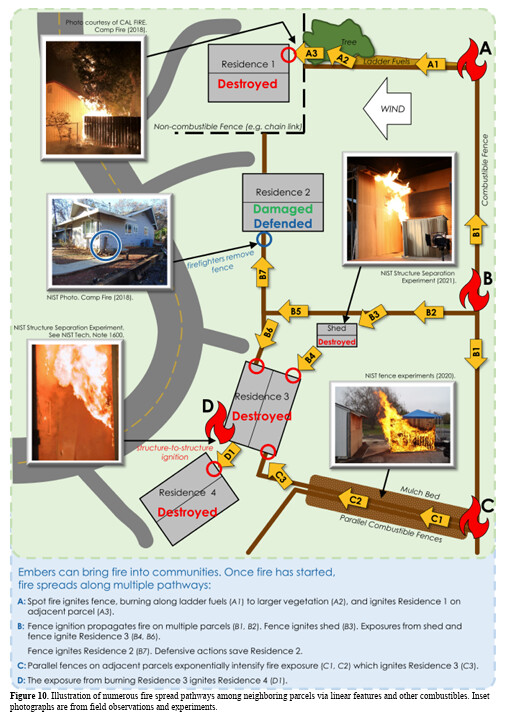
Firefighters and wildfire scientists both consider combustible fences to be a primary cause for the quick spread of wildfire in the WUI.
2. Combustible fences: a source of fire spotting adjacent to structures
Beyond being a prime means to spread fire quickly, combustible fences cause fire through their own embers. Multiple experiments have shown that a combustible fence can generate fire spotting (light a secondary fire through embers) at a significant distance, much further than 5 ft away.
For instance, this published NIST report documents experiments demonstrating the ability of a combustible fence to light up a target mulch bed 23 meters [76 ft] away: “The space between the source and target was asphalt and concrete, representing a worst case (i.e., favorable) scenario for transport of the firebrands over the ground. Roads and driveways make this a realistic condition for a WUI neighborhood. Figure 16 shows the experiment in which a double lattice fence has been ignited… spot fires ignited in the target mulch bed 23 m from the firebrand source within 5 minutes after the wind machine was set to deliver high wind speeds.”
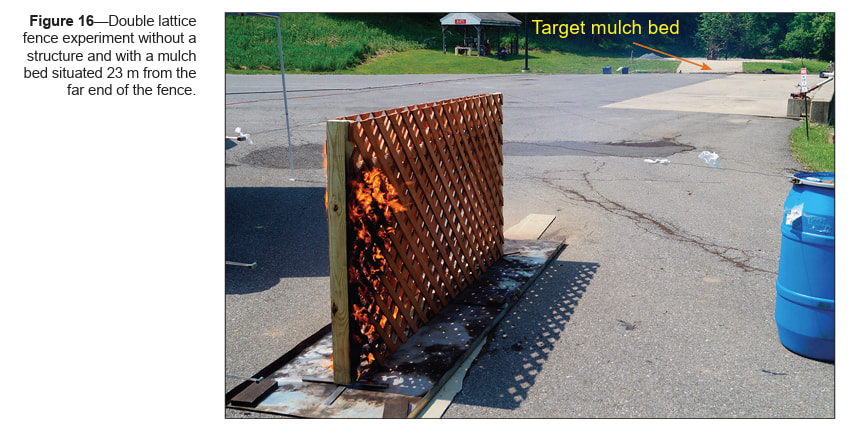
Original image source: U.S. Forest Service RMRS P-78. 2020
Combustible fences in Zone 0, on their own, can cause structure ignition through the fire spotting of their embers at a distance significantly longer than 5 ft.
3. Combustible fences: released heat that can ignite homes more than 5 ft away
Worse than causing structure ignition remotely through their own embers, fences can actually directly ignite structures on their own. Even further than 5 ft away, combustible fences provide enough combustion heat to ignite a structure. The following two images from the 2018 Camp Fire, two minutes apart, show a fence, 6 ft away from a structure, igniting it through combustion heat:
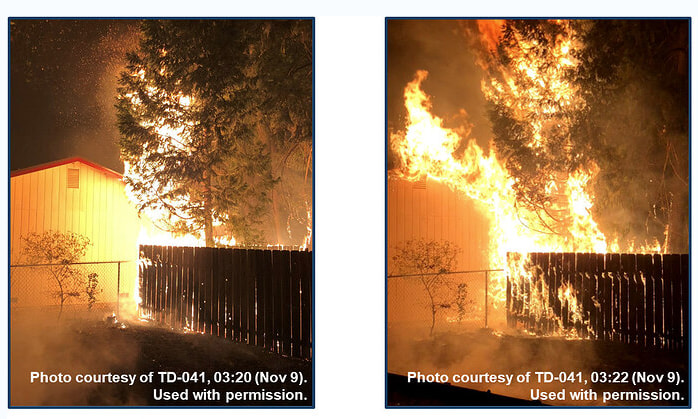
Original source: NIST Technical Note 2228 Update 1
We provide below links to two recent NIST videos, contributed by Dr. Erik Johnsson, which demonstrate the effect of combustion heat for two experiments with combustible fences, one with a wood fence, one with a composite fence. Both fences terminate 6 ft from a shed. There is no mulch bed under either fence. A small mulch bed in front of the shed shows the capability to ignite. A wind machine provides a constant 13 miles/hr wind (very low for a Diablo wind situation). The videos:
- Wood Fence NIST Experiment Video [Ignition: 0:45; target mulch bed ignition 17:51] : https://youtu.be/G4RKu1IgRgk
- Synthetic Fence NIST Experiment Video [Ignition: 1:29; Wind start: 3:29; target mulch bed ignition: 10:46]: https://youtu.be/hA80Mrov7z4
Combustible fences in Zone 0, on their own, can cause structure ignition through the released heat of their combustion at a distance longer than 5 ft.
4. Combustible fences near a structure may impact egress
Concerns about egress from a structure, in the presence of a combustible fence near Zone 0 have been frequently raised by firefighters. Now the wildfire science community agrees—from NIST Technical Note 2028-upd1: “Fences may impact egress. In a WUI fire, high and very high hazard fence configurations may result in a line of flames close to egress paths from a house or auxiliary dwelling. In one set of experiments on a wood-plastic composite fence, the top and bottom frames distorted and allowed burning boards to fall to either side. This created a 4 m (12 ft) wide zone of flames along the fence line.”
Interestingly, one of the videos provided by Dr. Erik Johnsson also demonstrates this effect, this time with a wood fence: https://youtu.be/G4RKu1IgRgk. At 15:19, a group of planks falls off the fence, progressively igniting over the next few minutes, and very largely increasing the area made inaccessible by the fence fire. At 17:09, more planks fall off, enlarging again the danger area. Had this fence been constructed alongside a house, a large area near that fence would have become inaccessible due to the fallen fence components burning on the ground.
Combustible fences near a structure may impact egress, potentially with deadly consequences.
5. IBHS certification does not allow any combustible fences in Zone 0
What the IBHS (Institute for Business and Home Safety) writes in Home Mitigations that Matter: “Combustible fences provide a path of fuel for fire to reach a home. Even for homes with noncombustible cladding, flames from a burning fence can threaten eaves and nearby windows. Installing a noncombustible fence inside Zone 0 breaks the path of fire to a home.”
It is difficult to underestimate the influence of IBHS on insurance companies. Already, in November 2025, at least one company, CSAA, has accompanied its non-renewal letters in California with a request for homeowners to adhere to the IBHS certification process, this year for the Base level, which is achievable by any homeowner (whereas, in the past years, the request for the Plus level was unachievable for most homeowners). If homeowners comply, they can get reinstated.
It would be a significant issue to have California state regulations that do not align well with the requirements that insurance companies put on homeowners. The situation could come where homeowners would invest large amounts of money in landscaping while becoming compliant with the California regulations, then find out, after an insurance non-renewal, that they have wasted the money invested in these projects (such as combustible fences in Zone 0) that might not satisfy their insurance company.
The IBHS certification Base 0 level requires, among other things, in its self-inspection checklist: “FENCES & RETAINING WALLS: Remove all combustible fencing materials (e.g., wood, vinyl) including posts, gates, and retaining walls within 5 feet of the home. Permitted noncombustible fences include metal (e.g., aluminum, chain link, steel, iron) or concrete. Fire-resistant materials (e.g., vinyl, composite, or fire-rated paint) are not permitted.”
IBHS does not allow combustible fences within Zone 0, connected to the house or not. For the first time, in 2025, an insurance company that is a major player in the California market (CSAA) is now requiring compliance to IBHS certification for non-renewal cancellation.
6. What does the California Department of Insurance think of fences?
The California Department of Insurance’s position appears largely aligned with the IBHS. In its “Safer from Wildfire" regulation, the California Department of Insurance lists 10 steps that homeowners should take. These steps essentially map to the requirements listed by the IBHS for Base level certification, although it makes a distinction between fences connected to the house and those that are not, while the IBHS does not.
Specifically as to fences, this is what it writes: “Replacing wood fencing connecting to your home with metal is critical because it can act like a candle wick leading fire straight to your home.” The same exact phrasing is included in their consumer guide. How long will it be before this becomes a requirement of insurance for the Fair Plan?
The California Department of Insurance does not recommend the use of combustible attached fences in Zone 0.
7. Is it cheaper to build a combustible fence in Zone 0?
In fact, when time comes to build a new fence, a metal fence can often be cheaper to build than a combustible fence. As a common example, the following metal section, one of many, 5 ft long, 6 ft wide, with 4.5 review stars, costs $99 at Home Depot (it is possible to find cheaper):
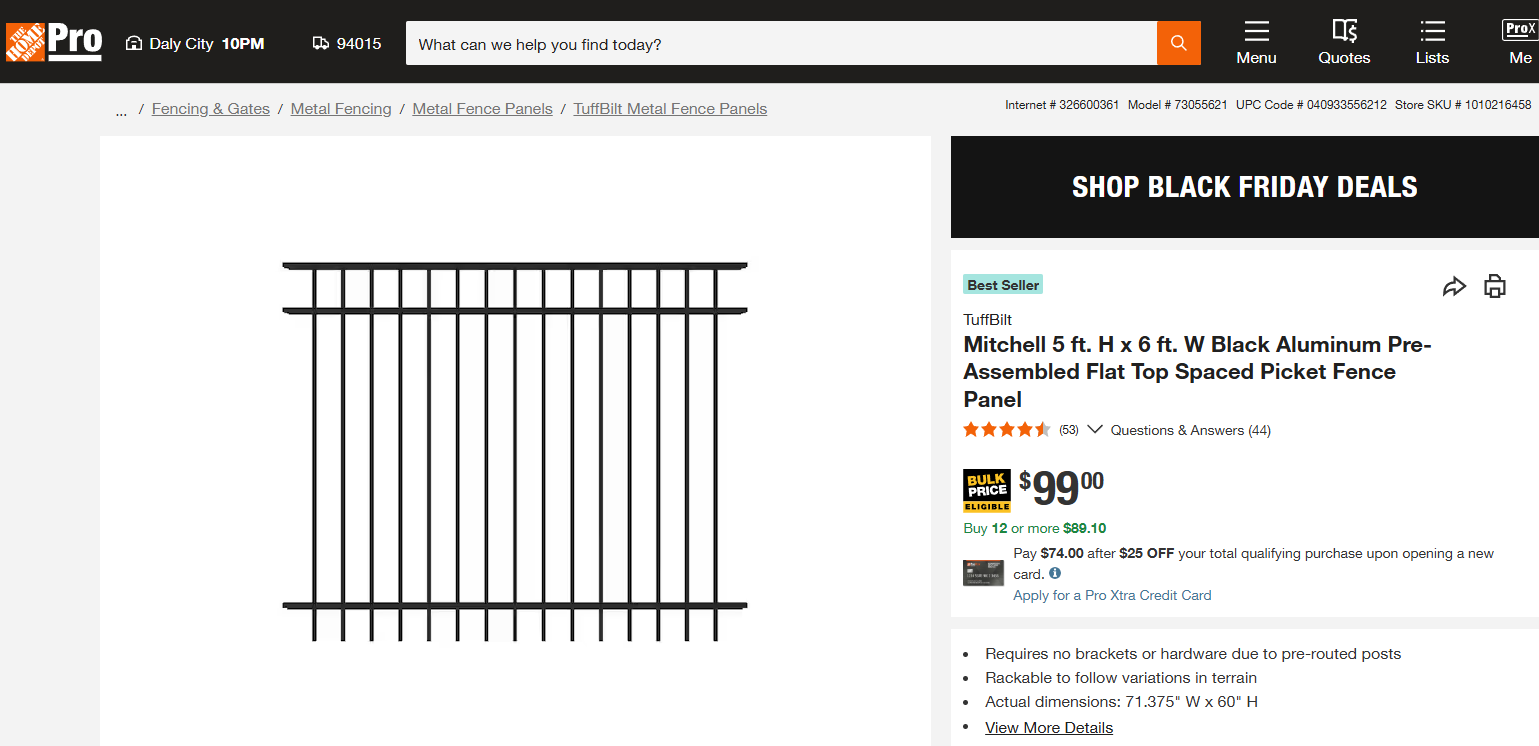
It requires the same amount of anchoring as a regular wood fence, and much less labor to install.
It is enough to browse a few minutes on Home Depot or Amazon to find out that metal fences do not have to cost more to build than wood fences.
It does not save money to homeowners to allow them to continue building combustible fences in Zone 0.
8. Is there significant economic benefit to continuing combustible fence use in Zone 0?
Is it possible that, despite the immense risk embodied in combustible fences near a structure, there could be, overall, an economic benefit to the logging industry? The key to this question is whether a large percentage of combustible fences today reside in Zone 0. What is this percentage?
In order to figure out the possible upside, HelpBerkeley.org, a wildfire-focused nonprofit in the San Francisco Bay Area, undertook a statistically significant study of combustible fences (the first of its kind) within the Very High Fire Hazard Severity Zone (FHSZ) in the WUI of Berkeley, California. The study is fully included in the present document, as Appendix 1.
Berkeley is a good illustration of an urban Northern California WUI, where the average lot is small and the penetration of combustible fences is high (an average of 140 ft per lot). The outcome of the study is that, regardless of lot size, the amount of combustible fencing within Zone 0 only amounted to 15% of the total amount of combustible fencing.
Therefore, there is no significant economic benefit to allow the continued use of combustible fences in Zone 0.
9. Both supporters and opponents agree on combustible fence removal from Zone 0
There have been hundreds of direct testimonies to the Committee since the beginning of 2025, from supporters and from opponents of strict Zone 0. Both supporters and opponents of strict Zone 0, when they have mentioned combustible fences, have always agreed that they should not be allowed. In fact, the only testimony we have ever heard in front of the Committee supporting the continuing use of combustible fences in Zone 0 came from a lobbyist for the logging industry.
It may be the only topic, along with plant debris, for which there has been universal support within public testimony. The removal of combustible fences from Zone 0 is one rare topic over which both opponents and supporters of strict Zone 0 agree.
10. Should we allow continued use of combustible fences in Zone 0?
The summary of the previous points made in the present document is:
- Firefighters and wildfire scientists both consider combustible fences to be a primary cause for the quick spread of wildfire in the WUI;
- Combustible fences in Zone 0, on their own, can cause structure ignition through the fire spotting of their embers at a distance significantly longer than 5 ft;
- Combustible fences in Zone 0, on their own, can cause structure ignition through the heat of their combustion at a distance longer than 5 ft;
- Combustible fences near a structure may impact egress with deadly consequences;
- IBHS does not allow combustible fences within Zone 0, connected to the house or not; For the first time, in 2025, a major player in the California insurance market (CSAA) is now requiring compliance to IBHS certification to resolve a policy non-renewal;
- The California Department of Insurance does not recommend the use of combustible attached fences in Zone 0.;It does not save money to homeowners to allow them to continue building combustible fences in Zone 0.
- There is no significant economic benefit to allow the continued use of combustible fences in Zone 0;
- The removal of combustible fences from Zone 0 is one rare topic over which both opponents and supporters of strict Zone 0 agree.
On this basis, we cannot find a reason to support the continued use of combustible space, either for new construction or for replacement sections.
We strongly suggest to the Committee that:
- Removal of the 5 ft section of an attached fence or gate in Zone 0 be required
- No replacement be allowed for existing fences in Zone 0, be they attached or not
- No new construction of combustible fences in Zone 0 be allowed
11. What is the least-harm combustible fence in Zone 0?
Because of the dangerous ability that combustible fences have to quickly spread wildfire within a neighborhood, a least-harm combustible fence must not allow horizontal wildfire propagation.
Because combustible fences in Zone 0 can propagate fire through fire spotting of its own, or directly through combustion heat, a least-harm combustible fence in Zone 0 must provide minimum combustible material, and use combustible material that is difficult to ignite.
We oppose any type of combustible fence within Zone 0. Looking at the least harm possible, however, we consider the least-harm fence that is actually realizable by a DIYer or through the work of a local handyperson to be of the model displayed in Figure 1 below.
It is worth noting the following points:
- Numerous handypersons already build very similar fences, but where the horizontal members of the fence are made of wood (which would allow the quick spread of wildfire)
- The cost of this type of fence is less than the cost of a full wood fence;
- The anchoring of the fence is exactly similar to that of existing wood fences;
- The only combustible material used is 4”x4” pressure-treated dimensional lumber, spaced by at least 5 ft from post to post, mounted if possible on a concrete anchor (use of a Simpson-tie standoff bracket is preferable); 4x4” pressure-treated lumber is not easy to ignite on its own—-although it will ignite given enough time and heat exposure;
- There is no horizontal combustible structure, limiting the spread of wildfire;
- The closest distance between two pieces of combustible material is 5 ft;
- The material between posts is robust and long-lasting hogwire;
- The fence, as a whole, is stiffened by a top metal rod with a 3.4” square section, screwed into each post top (the use of a stainless screw is recommended);
- The hogwire, at its base, is stiffened and sandwiched by two rods, similar to the top rod described above, that are bolted through;
- The bottom rods are mounted directly to each post base, either by screws mounted at 45° or by L-brackets (preferrable; the use of stainless fasteners is recommended).
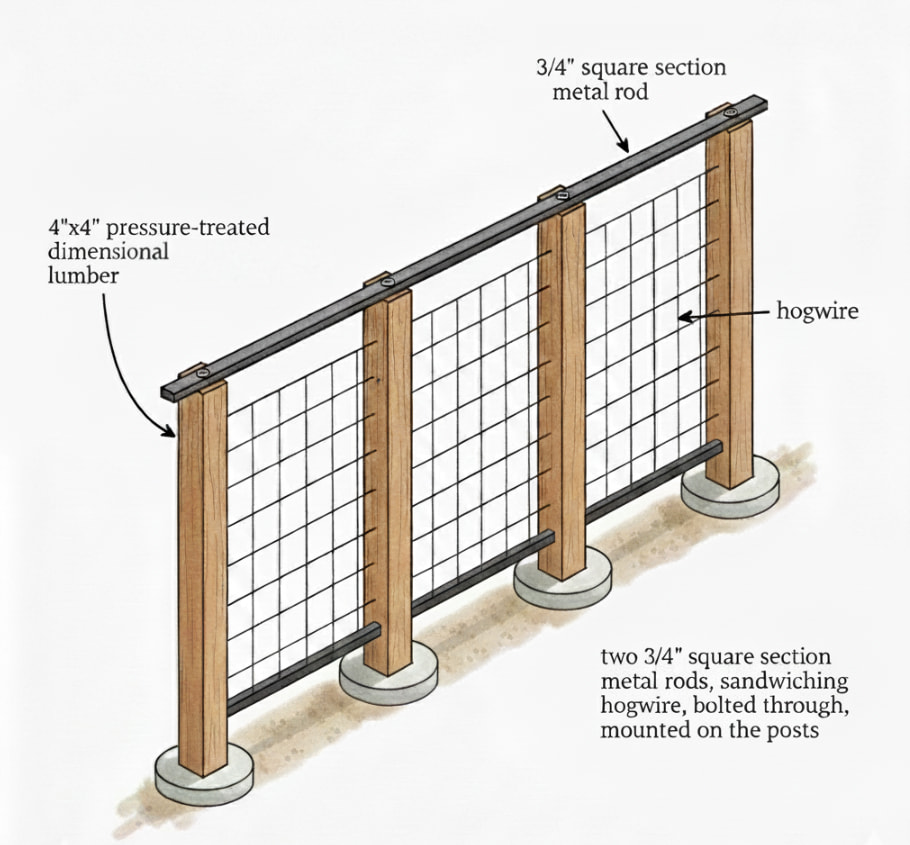
Figure 1: Least-harm combustible fence within the WUI
12. Least-harm language for continuing use of combustible fences in Zone 0
For the reasons discussed above, we strongly oppose the continuing use of combustible fences in Zone 0.
If, however, the Committee decides otherwise, after consultation with wildfire scientists and firefighters we believe that the least-harm way to allow combustible fences and gates in Zone 0 would be by:
- Allowing only construction methods with no ability to pass fire horizontally (for instance as described above)
- Allowing only construction methods that use exclusively dimensional lumber of sections no less than 4”x4” nominal (for instance, lattice fences ignite easily)
- Requiring fence topologies with a guaranteed 5-foot gap in every direction to insulate from fire pass-through
- Requiring that combustible fences carry their own Zone 0 around them, in the same manner as other structures do, until they reach their non-Combustible span. They would be treated similarly to an attached deck under § 1299.02: “A Building or Structure, for the purpose of an ember-resistant zone, includes an attached deck.”
There are complicated possible topologies for connected fences, which may separate into multiple connected fences, loop back, and connect to neighbors’ fences. The language to regulate these possible configurations is tricky and delicate. If the Committee decides that it will allow continued use of combustible fences in Zone 0, we propose the following language, that we believe provides least-harm scenarios for combustible fences in Zone 0:
“(5) Fences that are directly attached or adjacent to a Building or Structure shall have a five-foot (5 ft) non-Combustible span at the point of attachment. After the effective date of this regulation, no new or replacement Combustible fences are permitted within five feet (5 ft) of a Building or Structure including an attached deck.
However, a Combustible gate or fence, adjacent or attached to a Structure, and all Combustible gates or fences that it connects to, may be treated as a part of such Structure for the purpose of an ember-resistant zone, provided that (a) they terminate, within the property line, in all directions away from the house, into a five-foot (5 ft) non-Combustible span, or an air gap to connecting fences; (b) no part of such gate or fence be made of Combustible material of lesser section than 4”x4” nominal; and (c) the fence or gate be constructed in such a manner that it may not allow the horizontal spread of fire along any part of its length.”
Important notes:
- The least-harm fence described above satisfies the requirement of the provided language
- The language we are providing within this document is different from that provided in our previous document to the Committee, titled Zone 0 Rule Plead for Zone0 2025-10-23 Corrected V6.docx. The research we underwent to produce the present document leads us to believe that it would be exceedingly dangerous to allow the use of just any kind of combustible fence within Zone 0, hence the modifications suggested in the language above.
Appendix 1: Statistical study: what percentage of combustible fences are in Zone 0?
Original study: Statistical analysis in Berkeley, CA: combustible fences in Zone 0 - Wildfire defense - Berkeley Firewise