# Getting started with Zone Zero: Take inventory, then take a first step!
by Brent Blackaby
Last summer, after the Berkeley City Council unanimously approved the Fire Department’s EMBER proposal — along with amendments and modifications I introduced to improve implementation based on community feedback — it was time for our us to get started on Zone Zero right here at our own home.
Fortunately, in previous years, our family had already done vegetation management work in our front yard to meet Zone 1 standards for creating a a “lean, clean, and green” 30-foot defensible space around our home. That’s a good place to build from. But Zone Zero requires more effort and care in the first 5 feet around the perimeter of our home, both in the front yard and back.
So first, we took a quick inventory. Where would we really need to focus our attention? And ultimately, where should we start first, to get the ball rolling?

The good news is, we already have some natural Zone Zero advantages around parts of our home:
- Directly out front, we have a driveway leading into our garage — offering at least 20 feet of noncombustible space extending all the way out to the street. Great!
- Along one side of our home, we have a cement sidewalk separating our home from our neighbor’s that heads down to the backyard, with a small gravel bed for drainage in between the sidewalk and the house itself. All told, that offers 5-6 feet of clearance between our home and the property line. With the exception of a few combustible odds and ends I’ve stored in that area, like a ladder and lawnmower that I can easily move to a different location, this side is in good shape too.
- In the back yard, we have an 18-foot patio composed of paver stones that extends from the entire west-facing side of the house. There is an elevated deck that covers part of the patio, accessible from the home’s upper story, that I will need to ask the Fire Department about, as well as some big bushes that touch that deck. But the ground level patio itself provides a great existing noncombustible buffer.
That’s the good news. But in taking inventory, we also identified areas we’d need to work on:
- In the front yard, we have some camelias, ferns, other smaller bushes, and ground cover — as well as mulch — in much of our Zone Zero. We’ll need to address those.
- We have three Italian cypress trees posted in different locations 4-6 feet away from our home. While they look nice, they’re extremely flammable. We’ll need to remove them.
- We also have a nice Japanese maple in our front yard, only about 4 feet from our house, that’s still young and needs to mature. Should we move it? Can we extend our Zone Zero around it? We’ll need more guidance from the Fire Department to figure out how to proceed.
- We have a lovely lemon tree located 5-6 feet from the house that needs to be carefully pruned. Ultimately we will want to encourage branches to grow out toward the street rather than into the house.
- There’s a large, tall, full tree next to the driveway with branches that extend over the roof and into the side of our home. We need to create more horizontal clearance, but it’s tall and we can’t do it on our own. We’ll need an arborist to help us.
- One one side of our house, we have a small wooden gate at the bottom of the sidewalk leading to our backyard, and on the other side of the house we also have a small wooden fence segment touching our house. We’ll need to replace those with noncombustible materials.
- We also want to screen with wire mesh the vents under the eaves all around our home, as well as cover our gutters with mesh to prevent leaves from collecting and becoming a fire hazard. While not explicitly required by EMBER, I’ve learned that these are very cost effective home hardening tasks that are relatively inexpensive (BFD will provide the materials for free!) and hugely important for preventing ember ignition.
That’s not a short list! We certainly couldn’t tackle it all at once. But where should we start?
For me personally, the most difficult step to take is usually the first one. Inertia is a powerful force. So just changing from “no motion” to “motion” is often the biggest hurdle. I wanted to make that shift as simple as possible by tackling a first project that I could easily accomplish in a weekend.
So last August, we decided to start somewhere easy, to get the ball rolling. We decided to trim some of the branches out of our big driveway tree and our small lemon tree — and to also pull up some of the weeds and bushy overgrowth in the front yard next to our house and our front porch.
Fortunately, some Firewise Communities in our area were organizing a “Prepare for Fire Season” weekend event in August, encouraging neighbors all along the Grizzly Peak Ridge to take an hour or two to remove vegetation from their yards — even scheduling a bunch of appointments with BFD’s chipper program to make it easy to haul off all the debris. (Side note: I highly recommend taking advantage of the chipper program — for your own home, or for your neighborhood!) A weekend event like this really helps people feel like we’re all in this together.
That was just the catalyst we needed. My trusty sidekick and I spent a few hours on a Saturday afternoon weeding, trimming, pruning, and clearing. And we stacked up a big pile of branches, leaves, and weeds for the chipper to haul off the following Monday.
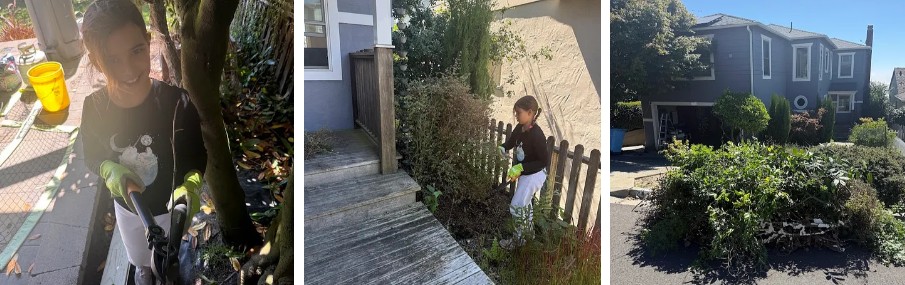
That Sunday afternoon, we celebrated a weekend of productive work with friends and neighbors at a picnic at Crescent Park in Park Hills — all told, amassing 55 cubic yards of debris across 46 different chipper pickup piles over an August weekend. It was fun to see everyone and feel good about the work we had each done to make our homes and our neighborhood safer.
And it was a great way for our family to take a relatively easy first step as we embark on our journey to full Zone Zero compliance.
Now our inertia has shifted toward motion — and we have more steps to take. Stay tuned.